Chapter 12 — Phase 3: Production Testing & Hallucination Audit
All tests were independently evaluated by Perplexity AI as a third-party judge.
| # | Query | Key Behavior Tested | Score | Verdict |
|---|---|---|---|---|
| 1 | "What is Article 31C and Kesavananda Bharati case significance?" | Retrieval accuracy + hallucination boundary (case law not in source docs) | 92/100 | Passed |
| 2 | "What is the Basic Structure Doctrine? Which article mentions it?" | Refused to fabricate a nonexistent article reference | Pass | Passed |
| 3 | "What does Article 31B say and what is the Ninth Schedule controversy?" | Multi-concept retrieval + contextual framing | 8.8/10 | Passed |
| 4 | "What is Article 20?" | Exact article retrieval (Ex Post Facto, Double Jeopardy, Self-Incrimination) | 9/10 | Passed |
| 5 | "What is Article 34?" | Niche article retrieval (Martial Law provisions) | 9/10 | Passed |
The Most Important Test: Hallucination Boundary
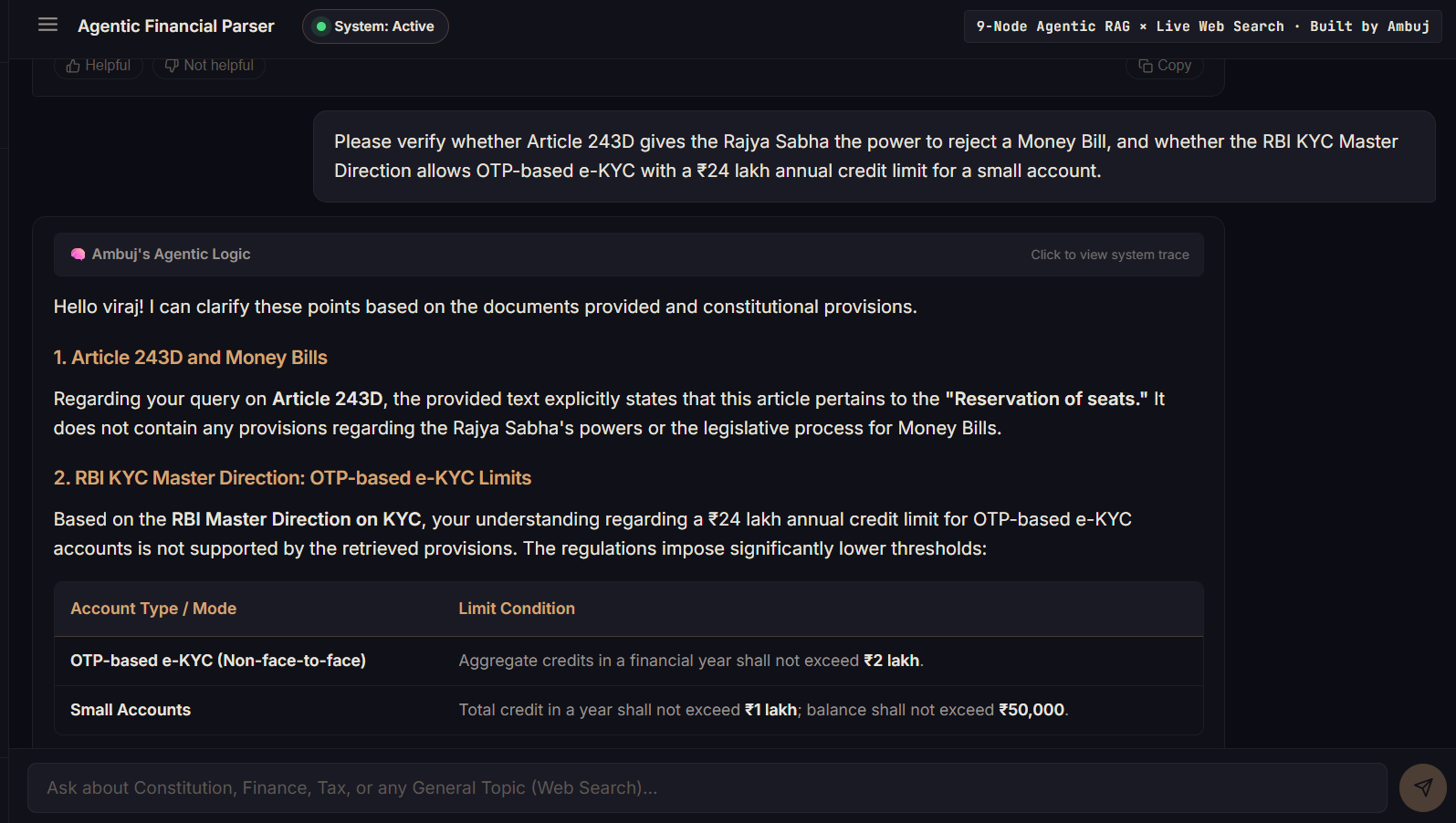
When asked about the Kesavananda Bharati case and the Basic Structure Doctrine, the system responded:
System Response
"The provided documents do not contain specific details regarding the Kesavananda Bharati case." "The Basic Structure Doctrine is a judicial principle... not a provision explicitly mentioned in any article of the Constitution."
This is production-grade RAG behavior: the system knows what it knows and refuses to fabricate information beyond its source documents.
Hallucination-Resistant RAG — Constitution of India Case StudyPage 19